

 Login
Login



BDKRB2 upregulation by dystrophic microglia drives pain hypersensitivity in aged mice
Release time:2026-08-24
Hits:
- DOI number:
- 10.1038/s41401-026-01907-5
- Journal:
- Acta Pharmacologica Sinica
- Abstract:
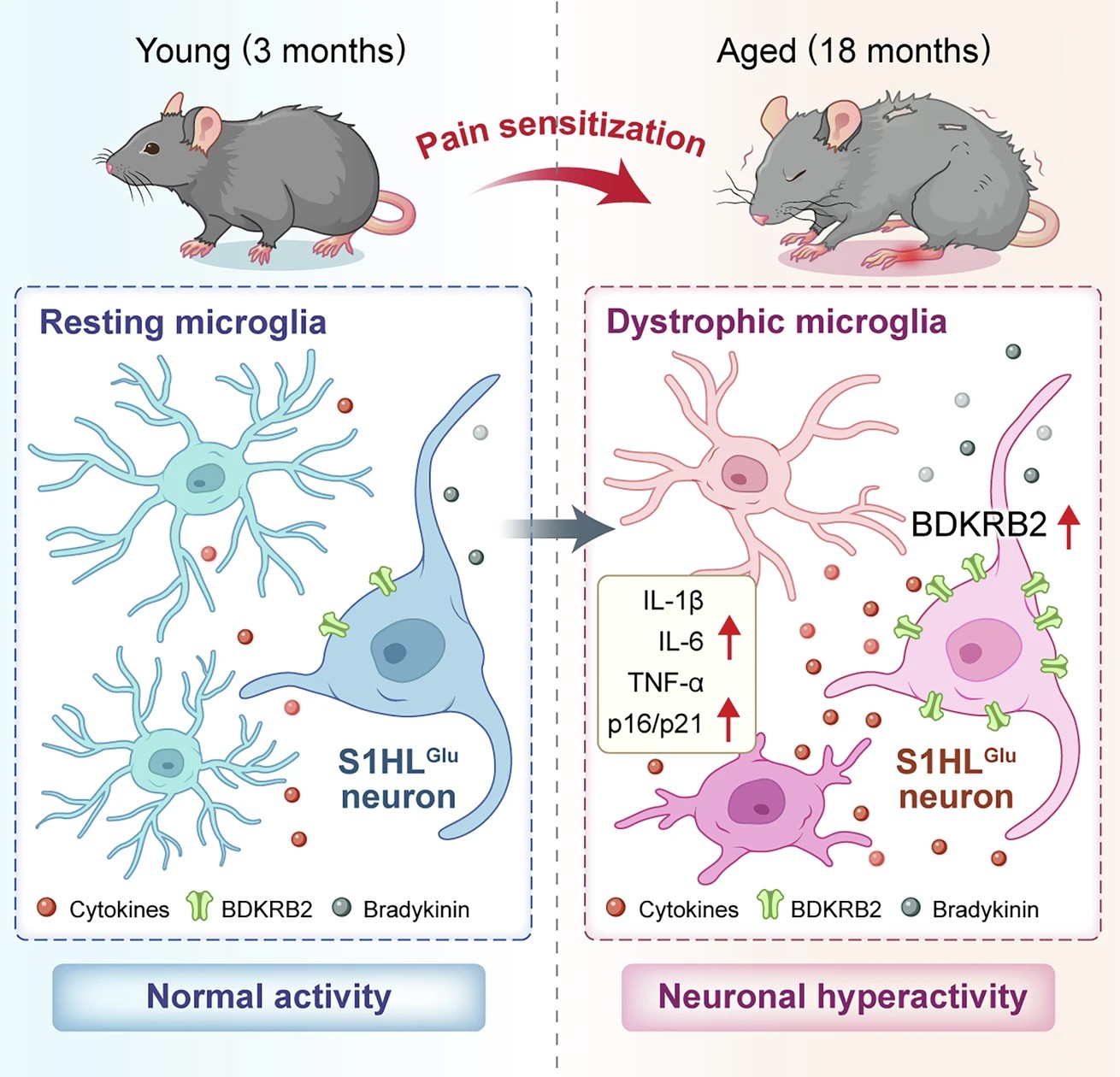
- Although pain sensitization is among the most common conditions affecting the elderly, its underlying neural mechanisms remain unclear. Here, we found that mechanical hypersensitivity arises from enhanced glutamatergic excitability in primary somatosensory cortex due to bradykinin receptor B2 (BDKRB2) upregulation by dystrophic microglia during aging. Specifically, in vivo fiber photometry in aged mice revealed hyperactivity of glutamatergic neurons in primary somatosensory cortex of hindlimb (S1HLGlu), while chemogenetic inhibition of these neurons reverses pain hypersensitivity in aged mice. BDKRB2 expression on S1HLGlu neurons is significantly increased in aged mice, whereas its conditional knockdown restores pain sensitization, and its overexpression leads to nociceptive hypersensitivity in young mice. Moreover, chemogenetic or pharmacological inhibition of dystrophic microglia in aged mice reduces BDKRB2 levels, alleviating pain hypersensitivity. The present study thus demonstrates that microglia-mediated S1HLGlu hyperactivity drives development of aging-related pain via BDKRB2 signaling, suggesting several potentially effective therapeutic targets for treating geriatric pain.
- First Author:
- An Liu, Ming-jun Zhang
- Co-author:
- Jin-rong Guo, Han Chu, Song-bin Liu, Dan-yang Chen
- Indexed by:
- Journal paper
- Correspondence Author:
- Yuan-zhong Kai*, Peng Cao*, Zhi Zhang*
- Translation or Not:
- no
- Date of Publication:
- 2026-08-17
- Included Journals:
- SCI