崔华
开通时间:..
最后更新时间:..
点击次数:
DOI码:10.1021/acs.analchem.5c06993
发表刊物:Analytical Chemistry
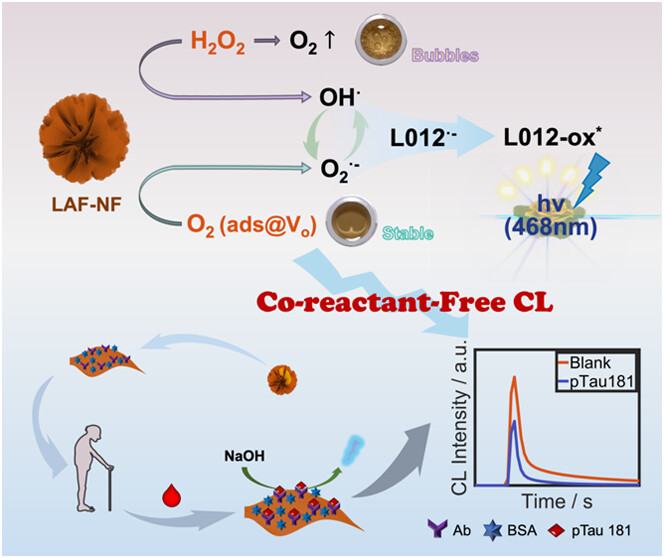
摘要:The detection of phosphorylated tau (pTau181), a key biomarker for Alzheimer’s disease, remains challenging due to its ultralow physiological concentration. Chemiluminescent sandwich immunoassays provide high sensitivity, but their accuracy is compromised by truncated tau fragments that lack the secondary antibody epitope as well as by the instability of peroxide-based coreactants. Here, we developed a nanoflower with inherent oxygen vacancies, synthesized through a one-pot method, involving 8-amino-5-chloro-2,3-dihydro-7-phenylpyrido[3,4-d]pyridazine-1,4-dione (L012), dicarboxylic ferrocene (Fc), and HAuCl4, named L012-Au-Fc nanoflower (LAF-NF). As a self-sufficient chemiluminescent microreactor, LAF-NF can efficiently catalyze adsorbed dissolved oxygen to generate strong, stable chemiluminescent emission without peroxide coreactants, achieving a 161-fold enhancement in the intensity over the L012 system. On this basis, a coreactant-free and label-free immunoassay for pTau181 using LAF-NF as the nanointerface was designed. The LAF-NF sensor achieved an ultrasensitive detection limit of 2.9 fg/mL and demonstrated excellent selectivity over total tau, theoretically eliminating immunoassay errors caused by epitope loss. This work offers a powerful platform for early Alzheimer’s disease diagnostics.
第一作者:李丹阳
合写作者:郑可颖,张婼娴,卓林锋,聂威,贾明玉
论文类型:期刊论文
通讯作者:魏熹,崔华
学科门类:理学
文献类型:J
卷号:98
期号:14
页面范围:10502–10510
是否译文:否
发表时间:2026-03-31
收录刊物:SCI
发布期刊链接:https://pubs.acs.org/doi/10.1021/acs.analchem.5c06993?ref=PDF
