

Chen Wei
- Special Professor
- Supervisor of Doctorate Candidates
- Supervisor of Master's Candidates
- Name (English):Wei Chen
- Name (Pinyin):Chen Wei
- E-Mail:
- Education Level:Postgraduate (Doctoral)
- Degree:Doctoral degree
- Professional Title:Special Professor
- Alma Mater:the University of Akron
- Teacher College:School of Nuclear Science and Technology
- Discipline:Chemistry
Materials Science and Engineering
Nuclear science and technology
 Contact Information
- ZipCode:
- PostalAddress:
- Email:
- Scientific Research
Operando characterization of polymer structure, dynamics, and processing
Research Topics
My group develop in situ and operando nuclear magnetic resonance (NMR) and synchrotron X-ray scattering methods to reveal how polymer molecular structure evolves during synthesis, processing, deformation, and crystallization. By combining advanced spectroscopy, real-time processing platforms, synchrotron experiments, and AI-assisted data analysis, my research connects polymer chain structure and dynamics to hierarchical organization and material performance.
My group studies polymers as dynamic materials. NMR provides molecular-level information about chain structure, interactions, and mobility, while synchrotron X-ray scattering reveals orientation, crystallinity, phase structure, and morphology. Together, these tools help us to establish the structure-process-property in polymeric materials, including polyolefin, polyvinyl alcohol, and fluoropolymer.
1. Structure-Spectra Coupling | Machine-learning Assisted NMR Spectra Interpretation
Polymer properties begin with molecular architecture. Chain sequence, stereoregularity, composition, interactions, and local mobility determine how polymers crystallize, flow, deform, and perform. Yet these features are often difficult to resolve because polymer spectra are crowded and structurally heterogeneous. Establishing reliable links between chain structure, NMR signatures, and material behavior is therefore essential for designing polymers with predictable properties.
Our group contributes by developing multinuclear and multidimensional solid-state NMR methods that resolve complex polymer spectra, together with AI-assisted analysis that extracts structural information and links spectral features to molecular architecture and material properties.
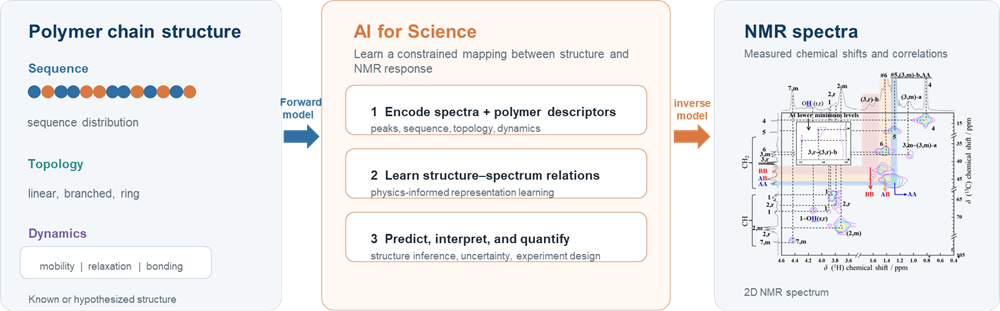
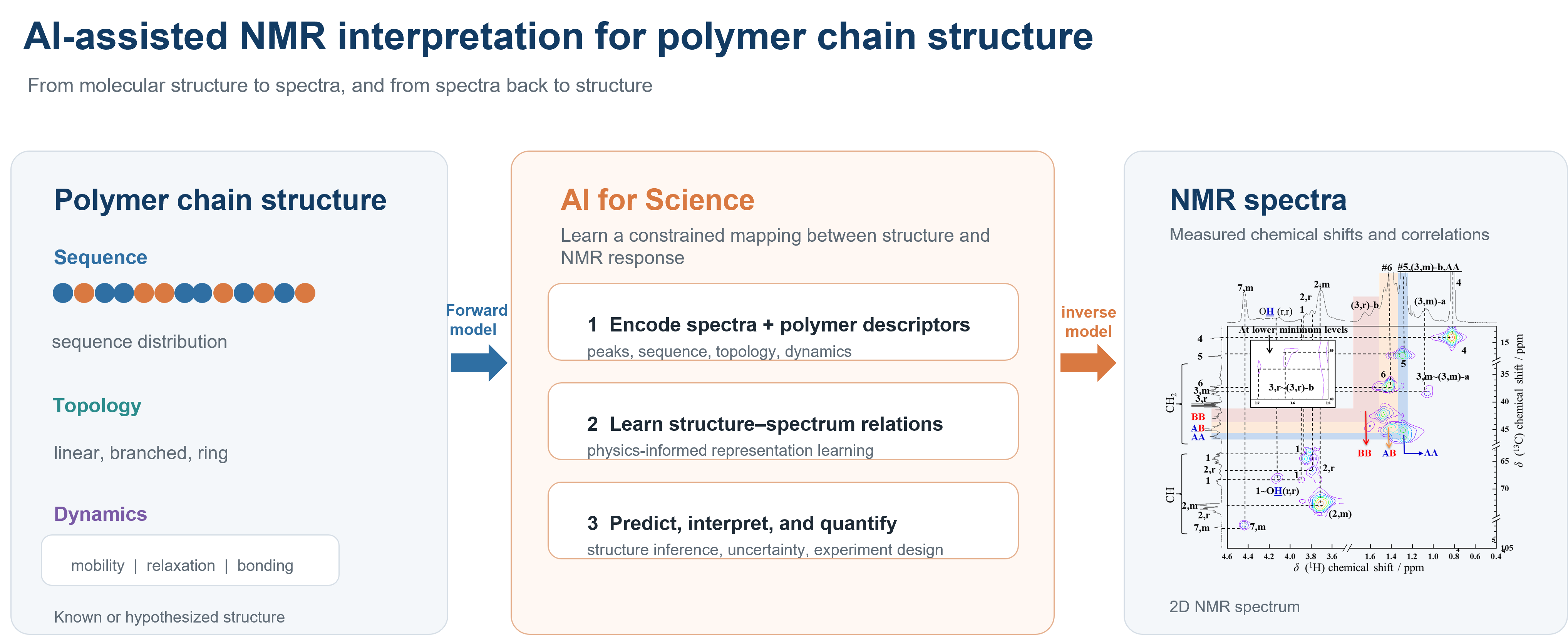
Approaches: multinuclear and multidimensional solid-state NMR, relaxation and dynamics measurements, and AI-assisted spectral analysis.
2. Polymer Processing | How do polymer structures evolve during processing?
Polymer processing is the moment when polymer structure is created and reorganized, which is a typical non-equilibrium process. Various physical parameters, i.e. temperature, flow, stress, solvent removal, and deformation can change chain mobility, orientation, crystallinity, and network structure on different time scales. Observing these changes in real time is essential for explaining why processing history controls final morphology and mechanical performance.
Our group contributes by integrating synchrotron scattering with NMR and custom processing platforms, allowing chain dynamics and structural changes to be measured under realistic conditions rather than inferred only from samples after processing.
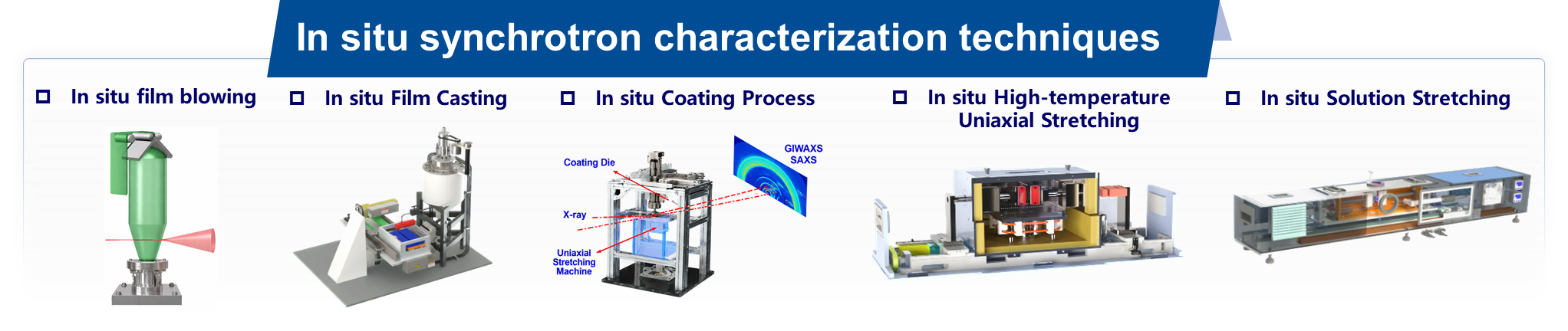
Approaches: in situ synchrotron WAXS and SAXS integrated with NMR and processing experiments.
3. Polymer Mechanics | Rheo-NMR for Structure-Mechanics Coupling
The mechanical behavior of polymers and soft materials is governed by how molecular chains rearrange under stress. Entanglements, crosslinks, chain orientation, relaxation, crystallinity, and transient interactions determine viscoelasticity, strain stiffening, yielding, toughness, and failure across multiple length scales. A central challenge is to connect these molecular processes with the macroscopic stress–strain response under realistic deformation conditions.
Our group develops rheo-NMR and operando NMR methods that combine mechanical loading with real-time measurements of chain dynamics, molecular orientation, relaxation, and network structure. By tracking structural changes during shear, stretching, compression, and recovery, we establish direct structure–mechanics relationships and identify the molecular mechanisms that control the performance of polymers, elastomers, hydrogels, and other soft materials.
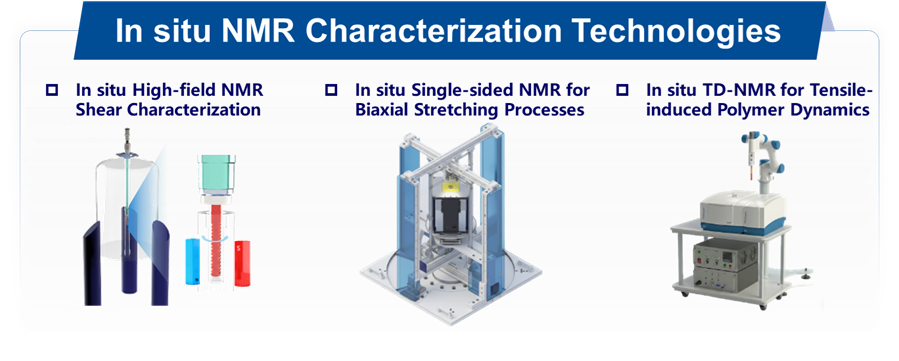
Approaches: time-resolved NMR combined with custom processing and mechanical platforms.
4. Polymer Adhesives | OCA for Foldable Displays and Adhesion Failure Mechanisms
Optical clear adhesives (OCAs) are essential components of modern display stacks, where they provide optical transparency while bonding thin, dissimilar layers. Foldable displays place especially demanding requirements on these interfaces because repeated bending, stretching, and recovery can produce cavitation, interfacial debonding, and irreversible damage. Understanding how OCA molecular structure and interfacial mechanics control these failure processes is essential for improving the durability and reliability of next-generation displays and other functional adhesive systems.
Our recent work focuses on OCA systems for foldable displays. By combining solid-state NMR with synchrotron X-ray scattering and mechanical adhesion measurements, our group probes molecular mobility, network structure, cavitation, and interfacial changes during deformation and debonding. These measurements connect molecular-scale dynamics and interfacial structure with the optical, mechanical, and failure behavior of OCA-based display assemblies, including under harsh or application-relevant conditions.
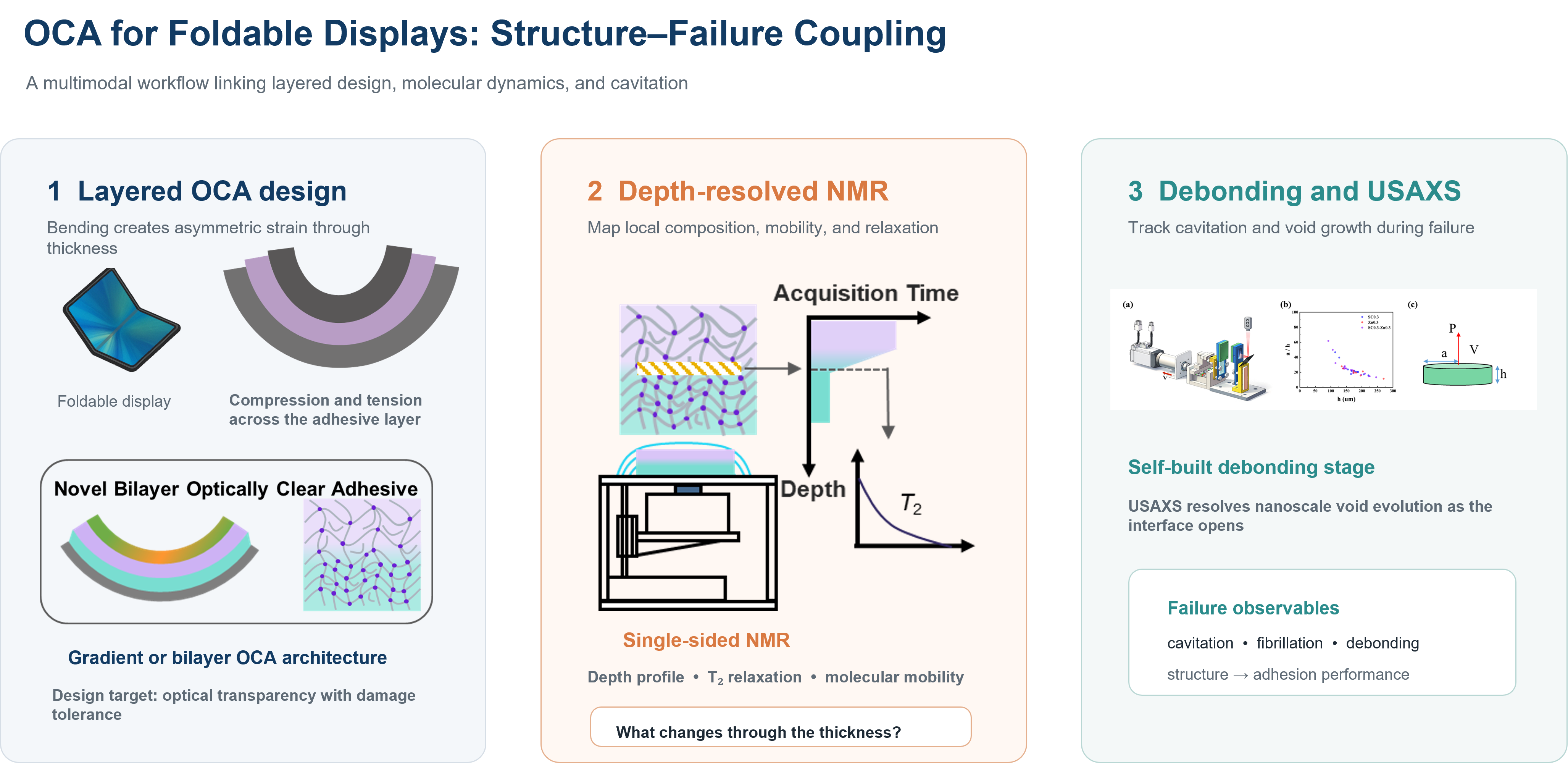
Approaches: solid-state NMR, in situ synchrotron X-ray scattering, and mechanical adhesion measurements for OCA and other functional adhesives.